
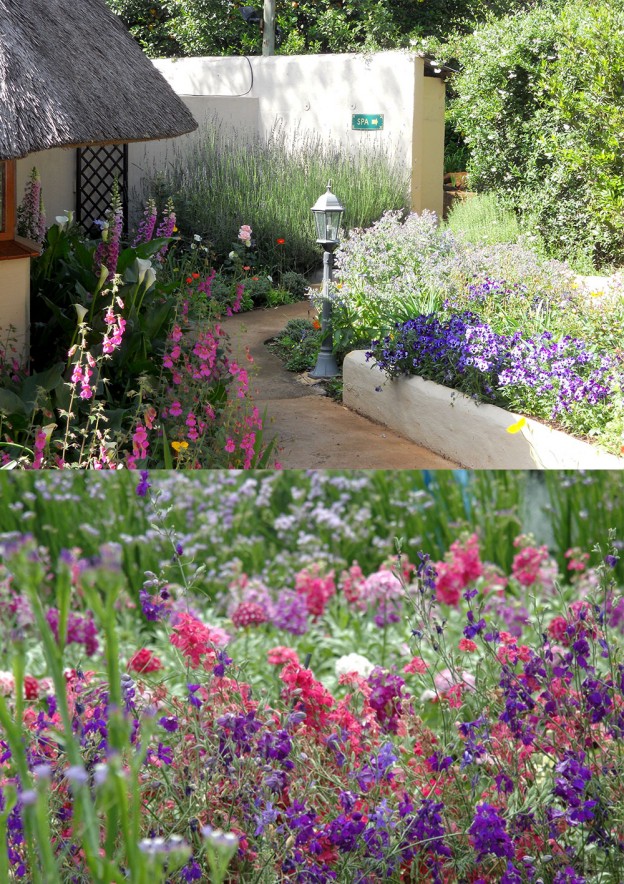
While Namaqualand gets all the publicity, the spring flowers of the KwaZulu-Natal Midlands grasslands are an absolute delight for those who don’t follow the crowds. Simply head up to the Midlands and enjoy the beautiful sprays of colour in our beautiful garden as well as the surrounding countryside.
See if you can spot some of the following flowers that begin to bloom in spring:
- CLIVIA MINIATA
Clivia miniata is one of our more famous plants in South Africa and, with its bright orange blooms, has become a favourite in gardens across the globe. Despite its international status, it actually originates from the KwaZulu-Natal woodlands and riverine forests and has become naturalised in areas with similar conditions. Clivias have been involved in extensive breeding programs throughout the years and, hence, the ones that you might spot in your supermarket or nursery will probably have larger blooms, variegation, different flower colours and even different leaf arrangements.
Some advice from our gardener: Although Clivias are apparently used to the harsh local weather, they do prefer to be planted under evergreen trees or shady areas. They can easily be planted with other shade plants. They also do well in containers. They dislike the hot afternoon sun which can burn their leaves and do not enjoy heavy frost.
(Sourced from HECKER NURSERY WEBSITE – heckers.co.za).
- FORTNIGHT LILY
Dietes iridioides is an evergreen, rhizomatous plant with a fan-shaped pattern of thin, strap-like leaves. In spring and summer, it bears beautiful white Iris-type flowers with yellow nectar guides and purple markings. Flowers close by midday except on overcast days.
Bees and other insects are attracted to the flowers.
Some advice from our gardener: The Fortnight lily grows and flowers very well in deep shade although it tolerates sunny conditions as well. They thrive growing under trees, which is very useful and enjoy regular mulching with compost or wood chips.
Do not cut back the flowering stems until they are finished flowering as the flowers are borne in succession along the stem. Young plants develop on the flowering stems.
(Sourced from RANDOMHARVEST.CO.ZA)
- STRELITZIA
Strelitzia reginae – part of the strelitzia family –is commonly known as the crane flower or bird of paradise flower. This can become a very large plant, although smaller varieties have been bred, and it loves shade. It is ever green, water wise and wind tolerant and attracts bees, butterflies and other insects.
The tough, grey-green leaves of Strelitzia reginae grow about 1,5 m tall with the flower heads reaching above the foliage. The stiff leaves grow up from the base of the plant and form large clumps.
Some advice from our gardener: These plants are very easy to grow and require little care. Plants are best obtained from reliable growers and should be tight in their bags, have a strong, full root system, visible, healthy, young growth and no dead or dying leaves.
For best results, grow Strelitzias in a rich loamy soil with plenty of water, fertilizer and compost throughout the year. Once established Strelitzias will thrive in most soils with very little water. Strelitzias are sensitive to cold and frost and must be placed in a sheltered position. In very cold climates, grow Strelitzias in pots that can be moved to shelter when frosty temperatures are expected.
They resent being moved and if disturbed they may sulk for a year or two before showing signs of growth.
(Author: Lorraine Solomon – sourced from KUMBULANURSERY.CO.ZA)
- LEDEBOURIA
Another common early spring flower is Ledebouria. 15 species are found in the summer rainfall areas of South Africa with a variety of spotted, textured, striped and coloured leaves in different sizes. The small flowers are usually pink or purplish, although some species have green flowers. The bulb is eaten by porcupines and, in some species, the leaves are grazed too. Pollination is thought to be by social bees, and seed dispersal is principally by water. Seed is washed away from where it was released by the mother plant to germinate nearby.
- ACALYPHA PEDUNCULARIS
This is commonly known as Brooms and Brushes and refers to the very different flowers on the male and female plants. The male flowers are red and white, clustered on a slender spike while the female flowers are a spidery puff of red elongated stigmas.
They are easy to spot and very common in Midlands grasslands, especially in recently burnt veld. The bright green nettle-like leaves are toothed, slightly hairy and clustered close to the ground on multiple stems.
There are 28 species of Acalypha in Southern Africa, while 430 occur in warm regions worldwide. The fist-sized rhizome is woody and branched. In traditional medicine in Zimbabwe, an infusion of the leaves is used to fatten babies while, in Zulu culture, infusions of bruised roots are used as emetic expectorants for coughs and colds.
(Source: www.meanderchronicle.co.za)
- CATS WHISKERS
Cat’s whiskers – Becium obovatum – attracts Blues butterflies to the very pale mauve or white frilly flowers. Perennial, this is a multi-stemmed ground cover that grows to about 30cm. The beautiful, frilly, mauve to white flowers are whorled at the tips of the branches from September to February and make a beautiful addition to a grassland garden.
Some advice from our gardener: This plant is drought resistant and is equally happy in sun or semi-shade. Its natural habitat is in grasslands and it is best grown in sun or semi-shade and makes a beautiful addition to a grassland garden, a rockery or as a container plant. Keep dry in winter. Blooms are seen in spring and summer in many-flowered clusters on long stalks. Pollination involves a series of butterfly species in habitat, adding to the willing gardener’s reward.
(Sources: www.wildflowernursery.co.za and www.midlandsmosaic.wordpress.com)